




ПРАКТИЧЕСКАЯ ГРАММАТИКА АНГЛИЙСКОГО ЯЗЫКА (МОРФОЛОГИЯ)
Mahsulot tavsifi
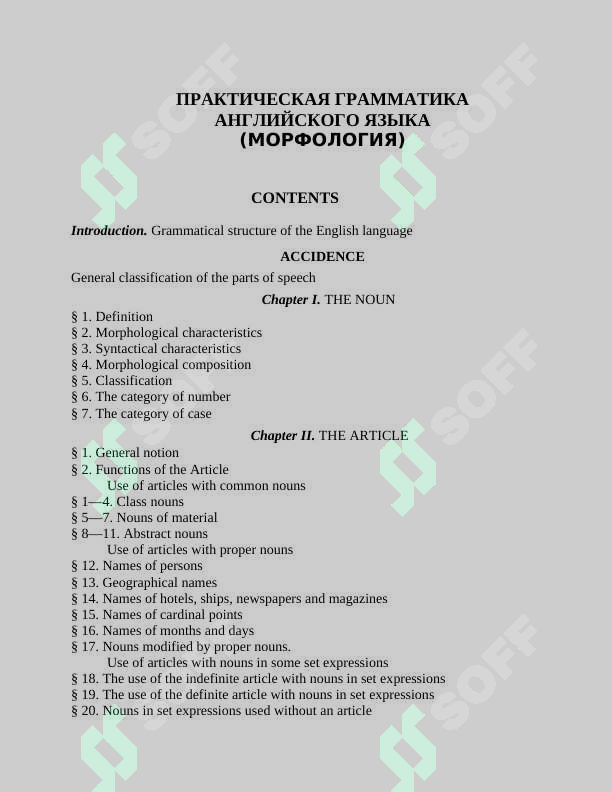
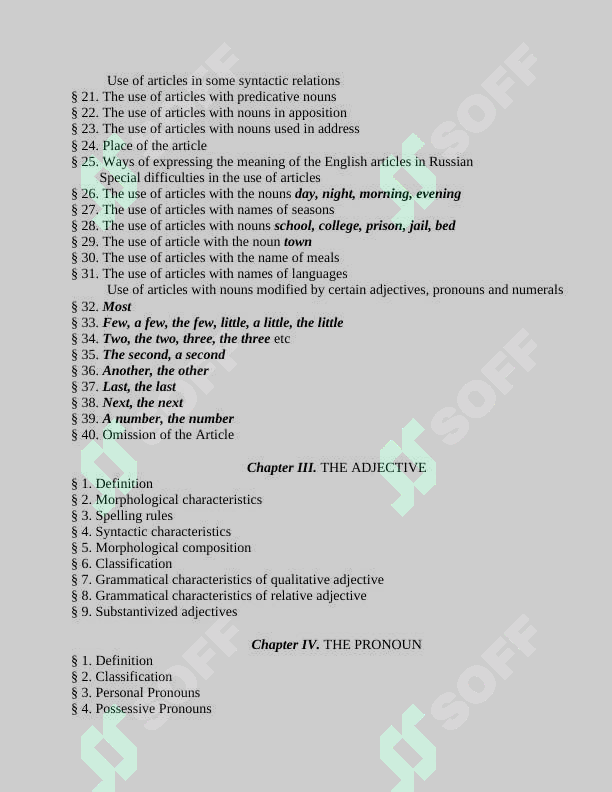
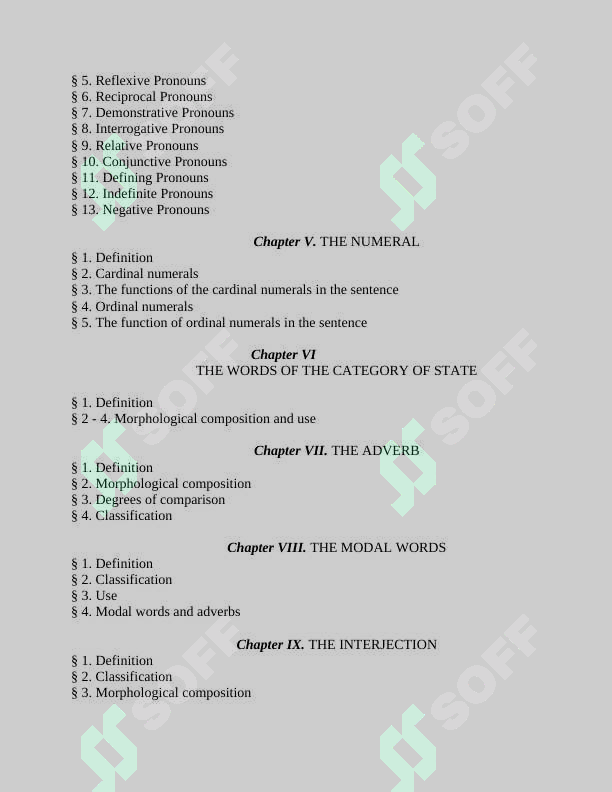
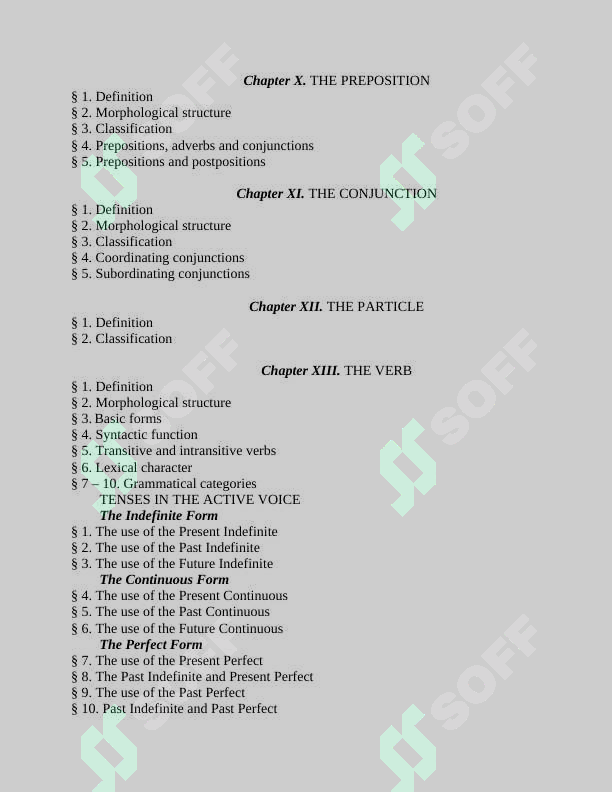
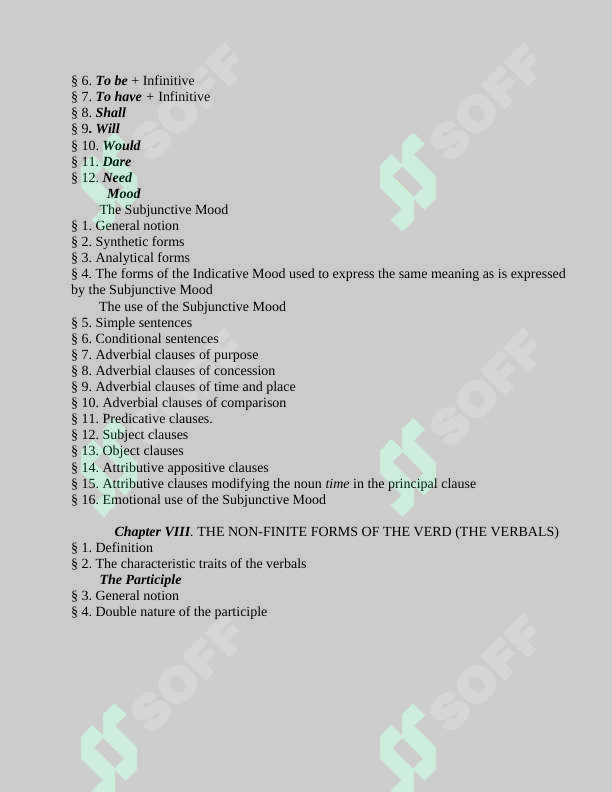
ПРАКТИЧЕСКАЯ ГРАММАТИКА АНГЛИЙСКОГО ЯЗЫКА (МОРФОЛОГИЯ) CONTENTS Introduction. Grammatical structure of the English language ACCIDENCE General classification of the parts of speech Chapter I. THE NOUN § 1. Definition § 2. Morphological characteristics § 3. Syntactical characteristics § 4. Morphological composition § 5. Classification § 6. The category of number § 7. The category of case Chapter II. THE ARTICLE § 1. General notion § 2. Functions of the Article Use of articles with common nouns § 1—4. Class nouns § 5—7. Nouns of material § 8—11. Abstract nouns Use of articles with proper nouns § 12. Names of persons § 13. Geographical names § 14. Names of hotels, ships, newspapers and magazines § 15. Names of cardinal points § 16. Names of months and days § 17. Nouns modified by proper nouns. Use of articles with nouns in some set expressions § 18. The use of the indefinite article with nouns in set expressions § 19. The use of the definite article with nouns in set expressions § 20. Nouns in set expressions used without an article Use of articles in some syntactic relations § 21. The use of articles with predicative nouns § 22. The use of articles with nouns in apposition § 23. The use of articles with nouns used in address § 24. Place of the article § 25. Ways of expressing the meaning of the English articles in Russian Special difficulties in the use of articles § 26. The use of articles with the nouns day, night, morning, evening § 27. The use of articles with names of seasons § 28. The use of articles with nouns school, college, prison, jail, bed § 29. The use of article with the noun town § 30. The use of articles with the name of meals § 31. The use of articles with names of languages Use of articles with nouns modified by certain adjectives, pronouns and numerals § 32. Most § 33. Few, a few, the few, little, a little, the little § 34. Two, the two, three, the three etc § 35. The second, a second § 36. Another, the other § 37. Last, the last § 38. Next, the next § 39. A number, the number § 40. Omission of the Article Chapter III. THE ADJECTIVE § 1. Definition § 2. Morphological characteristics § 3. Spelling rules § 4. Syntactic characteristics § 5. Morphological composition § 6. Classification § 7. Grammatical characteristics of qualitative adjective § 8. Grammatical characteristics of relative adjective § 9. Substantivized adjectives Chapter IV. THE PRONOUN § 1. Definition § 2. Classification § 3. Personal Pronouns § 4. Possessive Pronouns § 5. Reflexive Pronouns § 6. Reciprocal Pronouns § 7. Demonstrative Pronouns § 8. Interrogative Pronouns § 9. Relative Pronouns § 10. Conjunctive Pronouns § 11. Defining Pronouns § 12. Indefinite Pronouns § 13. Negative Pronouns Chapter V. THE NUMERAL § 1. Definition § 2. Cardinal numerals § 3. The functions of the cardinal numerals in the sentence § 4. Ordinal numerals § 5. The function of ordinal numerals in the sentence Chapter VI THE WORDS OF THE CATEGORY OF STATE § 1. Definition § 2 - 4. Morphological composition and use Chapter VII. THE ADVERB § 1. Definition § 2. Morphological composition § 3. Degrees of comparison § 4. Classification Chapter VIII. THE MODAL WORDS § 1. Definition § 2. Classification § 3. Use § 4. Modal words and adverbs Chapter IX. THE INTERJECTION § 1. Definition § 2. Classification § 3. Morphological composition Chapter X. THE PREPOSITION § 1. Definition § 2. Morphological structure § 3. Classification § 4. Prepositions, adverbs and conjunctions § 5. Prepositions and postpositions Chapter XI. THE CONJUNCTION § 1. Definition § 2. Morphological structure § 3. Classification § 4. Coordinating conjunctions § 5. Subordinating conjunctions Chapter XII. THE PARTICLE § 1. Definition § 2. Classification Chapter XIII. THE VERB § 1. Definition § 2. Morphological structure § 3. Basic forms § 4. Syntactic function § 5. Transitive and intransitive verbs § 6. Lexical character § 7 – 10. Grammatical categories TENSES IN THE ACTIVE VOICE The Indefinite Form § 1. The use of the Present Indefinite § 2. The use of the Past Indefinite § 3. The use of the Future Indefinite The Continuous Form § 4. The use of the Present Continuous § 5. The use of the Past Continuous § 6. The use of the Future Continuous The Perfect Form § 7. The use of the Present Perfect § 8. The Past Indefinite and Present Perfect § 9. The use of the Past Perfect § 10. Past Indefinite and Past Perfect § 11. The Future Perfect The Perfect Continuous Form § 12. The Present Perfect Continuous § 13. Present Perfect Continuous Inclusive and the Present Continuous § 14. The Present Perfect and the Present Perfect Continuous Exclusive § 15. The Past Perfect Continuous § 16. The Past Perfect Continuous Inclusive and Past Continuous § 17. The use of the Future Perfect Continuous The Passive Voice § 18. The use of the Passive Voice § 19. The use of tenses in the Passive Voice § 20. Ways of translating the Passive Voice into Russian § 21. Uses of the Passive Voice peculiar to the English language § 22. The PassiveVoice and the Nominal Predicate Modal Verbs § 1. Definition § 2. Can § 3. May § 4. Must § 5. Should and ought § 6. To be + Infinitive § 7. To have + Infinitive § 8. Shall § 9. Will § 10. Would § 11. Dare § 12. Need Mood The Subjunctive Mood § 1. General notion § 2. Synthetic forms § 3. Analytical forms § 4. The forms of the Indicative Mood used to express the same meaning as is expressed by the Subjunctive Mood The use of the Subjunctive Mood § 5. Simple sentences § 6. Conditional sentences § 7. Adverbial clauses of purpose § 8. Adverbial clauses of concession § 9. Adverbial clauses of time and place § 10. Adverbial clauses of comparison § 11. Predicative clauses. § 12. Subject clauses § 13. Object clauses § 14. Attributive appositive clauses § 15. Attributive clauses modifying the noun time in the principal clause § 16. Emotional use of the Subjunctive Mood Chapter VIII. THE NON-FINITE FORMS OF THE VERD (THE VERBALS) § 1. Definition § 2. The characteristic traits of the verbals The Participle § 3. General notion § 4. Double nature of the participle § 5. Tense distinctions § 6. Voice distinctions § 7. Functions of Participle I in the sentence § 8. Functions of Participle II in the sentence § 9. Predicative constructions with the participle § 10. The Objective Participial Construction § 11. The Subjective Participial Construction § 12. The Nominative Absolute Participial Construction § 13. The Prepositional Absolute Participial Construction § 14. Absolute constructions without a participle The Gerund § 15. General notion § 16. Double nature of the gerund § 17. Tense distinctions § 18. Voice distinctions § 19. Predicative constructions with the Gerund § 20. The use of the Gerund § 21. The functions of the Gerund in the sentence § 22. The Gerund and the Infinitive § 23. The Gerund and the Participle The Infinitive § 24. General notion § 25. Tense and aspect distinctions of the Infinitive § 26. Voice distinctions § 27. The use of the Infinitive without the particle to § 28. The functions of the Infinitive § 29. Infinitive constructions § 30. The Objective-with-the Infinitive Construction § 31. The Subjective Infinitive Construction § 32. The for-to-Infinitive Construction
Teglar
ПРАКТИЧЕСКАЯ ГРАММАТИКА АНГЛИЙСКОГО ЯЗЫКА (МОРФОЛОГИЯ)

Muallif
Soffchi PhD
Tasdiqlangan sotuvchi